"Water deeply and infrequently" is good advice that stops just short of being usable. Deeply to what depth? Infrequently by what interval? Most watering guidance never says, which is why "one inch a week" persists — it is the only number on offer, and it is wrong for most gardens most of the time.
This guide gives you the arithmetic instead. It is genuinely simple, and once you have run it for your own soil and your own crops, you will never need a generic schedule again.
The two numbers that make watering computable
Soil holds water like a sponge with a floor and a ceiling. Field capacity is what remains after excess water has drained away — roughly a day after a soaking, not immediately. Permanent wilting point is where water is still present but held too tightly for roots to extract it. The difference between them is the available water capacity, and it is the only water your plants can actually use.
| Texture | Inches per foot | Millimetres per 30 cm |
|---|---|---|
| Sand | 0.5–1.0 | 40–85 |
| Sandy loam | 1.0–1.5 | 85–125 |
| Silt loam / clay loam | 1.5–2.0 | 125–165 |
| Clay | Roughly 2.0–2.5 | 165–210 |
Plant-available capacity climbs steeply from sand to loam and silt loam, then levels off or falls slightly in heavy clay, with a practical garden range of about 1 to 2.5 inches per foot. Clay holds abundant total water, but a large share is bound too tightly for roots to use; total water and plant-available water are different quantities.
The second number is root depth, because you are refilling a reservoir whose size is set by how deep the roots go. Vegetables sort into three rough bands:
- Shallow, top 6–12 inches: lettuce, spinach, greens, radish, onion, celery, beet, broccoli, cabbage, cauliflower, most herbs.
- Moderately deep, top 1–2 feet: snap bean, cucumber, eggplant, pea, pepper, summer squash, potato, tomato, cantaloupe.
- Deep, top 2–4 feet: asparagus, lima bean, pumpkin, sweet potato, watermelon, winter squash.
Published lists genuinely disagree at the boundaries — carrot, sweet corn, cabbage and potato land in different classes in different tables. So treat these as three bands rather than a lookup, and when in doubt, dig and see where your own roots actually are.
Finally, you do not refill at zero. Management allowed depletion is the fraction of available water you let plants use before irrigating, and a common working guideline is to irrigate before 40 to 50 percent has been depleted. Past that, stress starts costing yield.
Turning "an inch of water" into something you can measure
The arithmetic is worth showing rather than citing, because it is just unit conversion. One inch of water over one square foot is 12 × 12 × 1 = 144 cubic inches. A US gallon is 231 cubic inches. So:
One inch of water over one square foot = 0.62 gallons. In formula form, gallons = area in square feet × depth in inches × 0.62.
Useful multiples: an inch over a 4 × 8 foot raised bed (32 sq ft) is about 20 gallons; over 100 square feet, about 62 gallons; over 1,000 square feet, about 623 gallons. The metric version is cleaner still — 1 mm over 1 m² is 1 litre, so an inch (25.4 mm) over a square metre is about 25 litres.
Now the earlier example becomes concrete. That 0.9 inches for the tomato bed, over a 4 × 8 foot bed, is about 18 gallons. If you know what your hose or emitters deliver per hour, you know your run time.
Check the root zone, at the right depth
Schedules drift out of step with the weather; the soil does not. Before watering, check moisture — but check it at a depth that matches the plant, not at the length of your finger. A finger checks the top three inches, which is right for a lettuce bed and useless for a shrub.
Push a trowel, a screwdriver, or a soil probe to root depth and feel what comes out. Dry and crumbly at that depth means water now. Cool and pliable means wait. A soil probe that pulls a core is the best tool here because it shows you the moisture profile rather than a single point — you can see whether last week's watering actually reached the bottom of the root zone or stopped four inches down.
Extension services publish a calibrated "estimating soil moisture by feel" procedure that maps ball-and-ribbon behavior to percent depletion by texture class. It is the cheap version of a moisture sensor and it is more informative than most people expect.
Wilting is a late and ambiguous signal. Midday wilt in heat, with moist soil, is often just transpiration outrunning uptake, and the plant recovers by evening. Wilting that persists into the evening, or that appears in the morning, is real. And wilting in wet soil means damaged roots, not thirst — adding water makes it worse.
Apply enough, then pause
Deep, infrequent watering encourages deeper rooting and more drought resilience. The goal is to moisten the intended root zone, then stop and let the plant use it.
But the headline rule has real exceptions, and pretending otherwise causes losses. Germinating seed, new transplants, shallow-rooted greens, containers, and sandy soils all legitimately want more frequent water. Seed needs the top inch consistently moist; a container has no reservoir to draw on. Deep-and-infrequent is a default for established plants in ground, not a universal law.
Verify rather than assume. After watering, dig or probe and see how far moisture actually reached. Most people are surprised the first time — either by how little penetrated, or by how much ran past the roots.
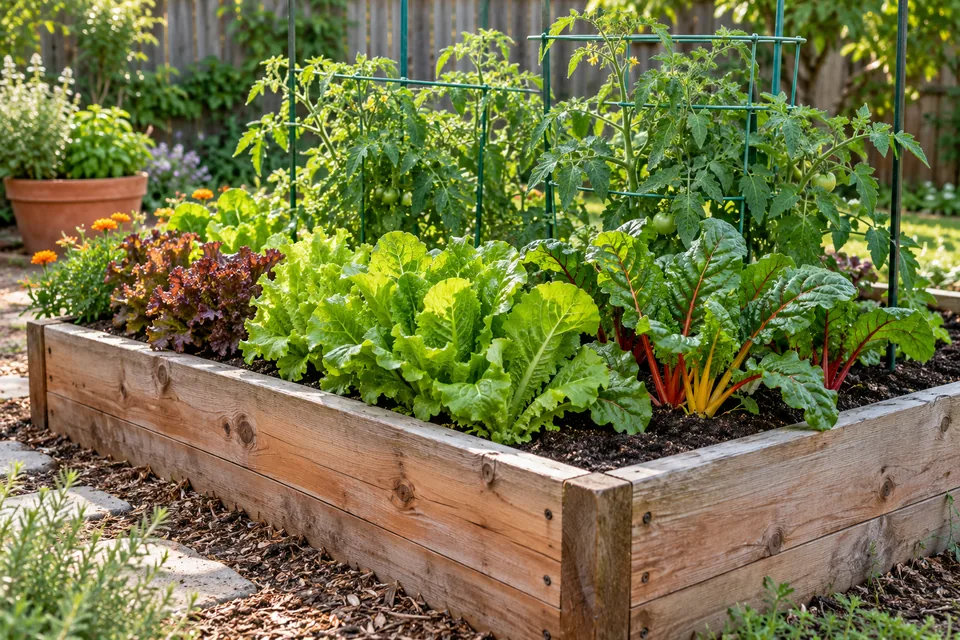
When beds hold mixed crops and you cannot separate the zones, there is a clean rule: schedule to the shallow-rooted crops. If their needs are met, the deeper-rooted plants sharing the bed will be adequately supplied.
Audit before you adjust
If you use sprinklers, the most valuable hour you can spend is measuring what they actually deliver. A catch-can test gives you two numbers: how fast you apply water, and how evenly.
Set out cans. Straight-sided containers — tuna, cat food, coffee cans — work, though most need a small rock inside to sit level. Use a minimum of 24 cans for a reliable result, spaced 5 to 8 feet apart for spray heads and 10 to 20 feet for rotors, or scattered across the pattern of a hose-end sprinkler.
Run the zone for a set time, then measure the depth in each can.
Precipitation rate = average catch depth ÷ run time in minutes × 60. A 15-minute run averaging 0.15 inches gives 0.15 ÷ 15 × 60 = 0.6 inches per hour, so an inch takes about 100 minutes. That single number converts every "inches" figure in this guide into minutes on your timer.
Distribution uniformity = sort the catches smallest to largest, average the lowest quarter, and divide by the overall average. Below about 60 percent, fix the system before you touch the schedule.
That last point deserves emphasis, because it is the least-disruptive fix and the one people skip. With poor uniformity you have to over-water the entire zone to keep the driest quarter alive. Uniformity is a water-quantity problem, not a cosmetic one — and clogged nozzles, mismatched heads, and misaimed sprinklers are cheaper to fix than the water they waste.
Let soil type change the pace — in two directions
Soil texture affects watering through two separate properties that push in opposite directions, and collapsing them into one sentence hides the practical lesson.
Storage. Sand holds little water per foot, so it needs watering more often. Clay holds much more, so it can go longer between waterings.
Intake. Sand accepts water quickly. Clay accepts it slowly — representative infiltration rates for clay soils run around 0.01 to 0.10 inches per hour, far below what a typical sprinkler delivers.
So clay wants longer intervals and slower application, while sand wants shorter intervals and tolerates faster application. A clay soil watered at sprinkler speed will run off long before the root zone is full — which is exactly the situation that calls for cycle and soak.
Cycle and soak means splitting a run into shorter cycles with pauses between them, so each application has time to move down before the next arrives. Applying half an inch, waiting, then applying another half an inch later the same day, delivers an inch that a single run would have sent down the driveway.
Finding your cycle length needs no calculation: run a zone and watch for the minute water starts to sheet or run off. That elapsed time is your maximum cycle length. Split the total into cycles no longer than that, separated by enough time for surface water to disappear. Runoff is worst on clay with moderate to steep slopes, which is where this technique pays off most.
Drip irrigation: how long to run it
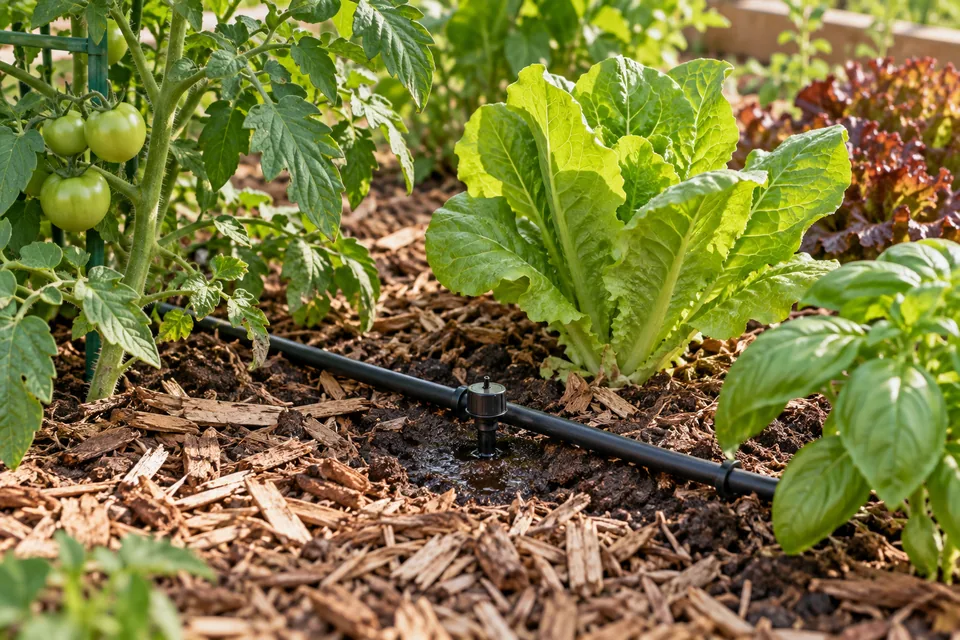
Drip delivers water slowly to the root zone with little evaporation or runoff, and it keeps foliage dry. The question it always raises is run time, and the arithmetic answers it.
Application rate for point emitters: (number of emitters × emitter gallons per hour × 1.604) ÷ area in square feet = inches per hour. The 1.604 is unit conversion again — one gallon per hour over one square foot is 231 ÷ 144 = 1.604 inches per hour.
Run time = gallons needed ÷ system delivery in gallons per hour. If your bed needs 18 gallons and your system delivers 6 gallons per hour, that is a three-hour run.
Two practical anchors. A single 1 GPH emitter in a 12-inch pot works out to roughly an hour per week, better delivered as three sessions of about 20 minutes than as one long run. And for beds, the guiding posture is "low, slow, and soak", aiming to wet 12 to 18 inches deep — which usually means running an hour or more. Short drip runs are the single most common home-garden drip error: people apply drip's slowness to a sprinkler's schedule and wet only the top two inches.
If you do not know your system's efficiency, add 10 to 15 percent to the calculated run time as a starting point, then verify by digging. As a sanity check rather than a schedule, vegetable crops as a class use roughly 1 to 1.5 inches of water per week at peak season, from rain and irrigation combined.
Choose a practical time
Water in early morning to minimize evaporation and shorten the period that leaves remain wet.
Most turf diseases develop when blades stay wet for longer than about 14 consecutive hours. Watering around 4 to 6 a.m. knocks off overnight dew, and the canopy dries after sunrise. Evening sprinkling extends leaf wetness through the night. Midday sprinkling loses water to evaporation and wind.
Water between roughly 6 and 8 a.m. whenever possible. If mornings are impossible, irrigate in the evening with drip or a soaker hose that keeps foliage dry.
New plants are not drought-tolerant yet
This is an expensive and common misunderstanding. Drought-tolerant and native species are not drought-tolerant until their root systems establish — the label describes a mature plant, not the one you just put in the ground.
Plan on supplemental water through an establishment period of one to two years for shrubs and small trees, and longer for larger stock. A useful rule of thumb for trees is that establishment takes roughly three to four months per inch of trunk caliper for roots to grow into the surrounding soil. During the first two years, check soil moisture at least weekly and water if it is dry at 6 inches; in many climates that works out to watering every 7 to 14 days when rainfall falls short of about an inch in the same period.
When you water a new woody plant, soak the whole root zone rather than sprinkling the surface, and water at the root ball and just beyond it, where the roots actually are. Then taper deliberately over the following seasons rather than stopping abruptly — that gradual reduction is what pushes roots outward and downward.
Reduce demand before adding water
The cheapest gallon is the one you never need. In rough order of leverage:
- Group plants by water need — hydrozoning. Putting a thirsty plant in a low-water bed forces you to irrigate the whole zone at the thirsty plant's rate. This is also why a lawn and a shrub bed should never share a controller zone; their water use differs by season and by species.
- Reduce turf area. Lawn is usually the largest single water demand in a yard, and converting even part of it to planted beds or unirrigated ground is the largest available saving.
- Choose adapted plants suited to your climate and to the specific spot, rather than fighting the site every summer.
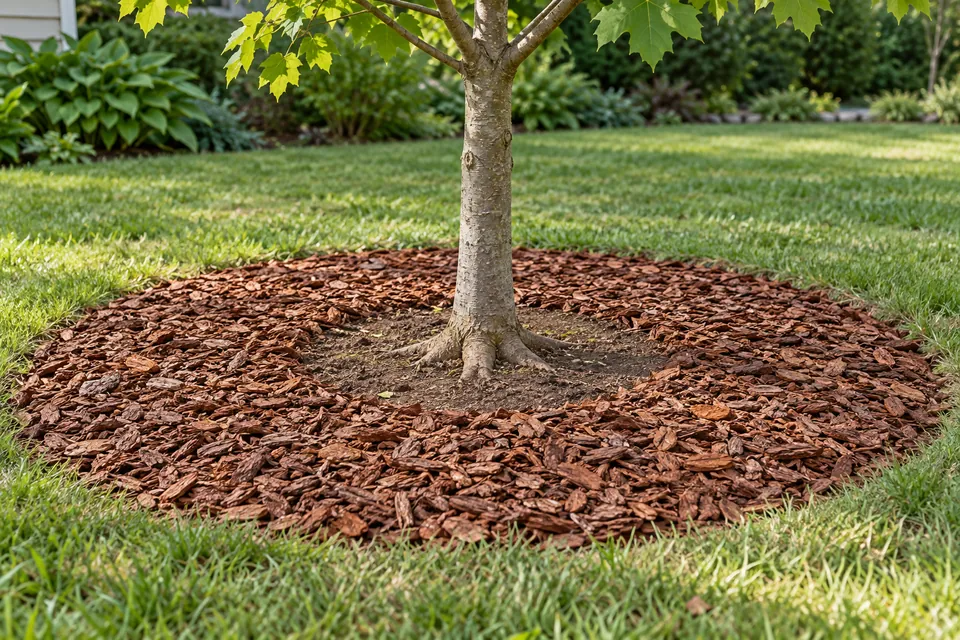
- Mulch. Two to three inches of organic mulch reduces evaporation from the soil surface, moderates temperature, and suppresses the weeds that compete for water. Keep it back from stems and trunks. Watch for two failure modes: fine mulches can form a hydrophobic crust that sheds water, and grass clippings applied thickly mat into an impermeable layer.
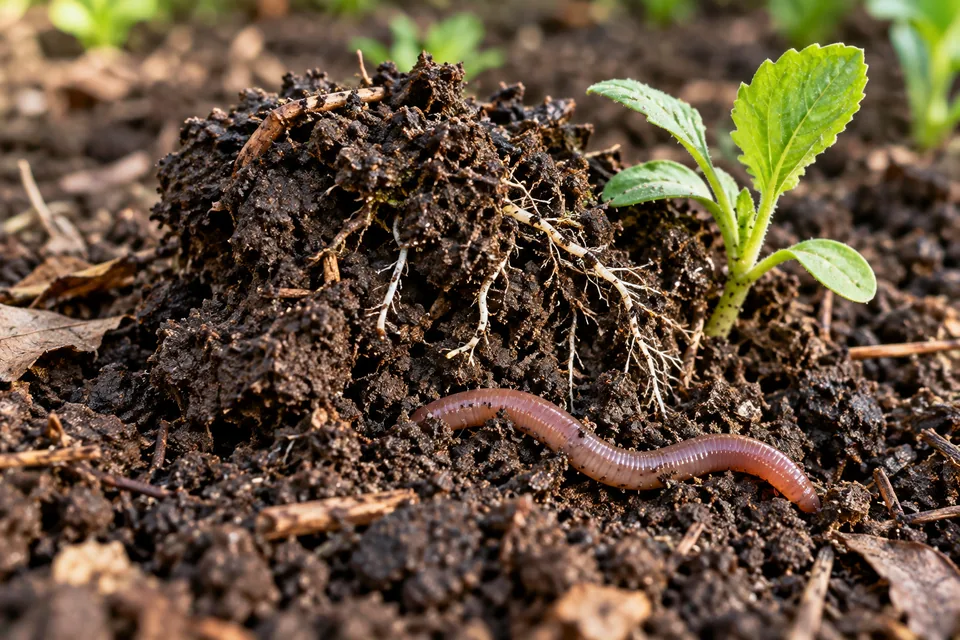
- Improve the soil. Keep living roots, add compost according to a soil test, mulch the surface, and reduce disturbance. These practices build aggregates and infiltration; see the soil guide for the full program.
- Fix leaks and misdirected sprinklers. Unglamorous, and often the biggest single number.
Long-term field results support that program. Rodale Institute measured water infiltration two to three times faster under long-term organic management and 7 to 13 percent more water in the crop root zone across a five-year comparison. Those results confirm the value of structure and continuous soil care; use the root-zone checks and irrigation math in this guide to set the actual schedule for your garden.
Containers deserve a specific warning because they break the headline rule. In heat, containers commonly need water daily or more than once daily. They have no reservoir, and a small pot in full sun can go from moist to critically dry within a day. Larger containers, grouping pots together, and mulching the surface all extend the interval. The container gardening guide covers pot size, mix, and feeding as well.
Respond to weather, not the calendar
Plant water use is driven by evaporative demand, which changes daily. The formal version of this is evapotranspiration.
Reference evapotranspiration (ETo) is the water use of a standardized, well-watered reference surface — effectively a weather number rather than a plant number, which is what makes it portable. Actual use is ETo scaled by a crop coefficient; in ornamental landscapes the equivalent multiplier is called a landscape coefficient. (Note that "potential ET" and "reference ET" are not synonyms, though popular writing often treats them as such.)
Free public ETo data exists in much of the country. California's CIMIS network runs about 145 automated weather stations with data free of charge and is used by landscape managers as well as growers. The US Bureau of Reclamation's AgriMet publishes daily crop water use charts for the Pacific Northwest and Great Plains. Elsewhere, search for your state's mesonet or agricultural weather network.
The scheduling method that uses it is simple bookkeeping, sometimes called the water-balance or checkbook method: add rainfall and irrigation, subtract daily water use, and irrigate when the balance has dropped by your depletion fraction of root-zone available water. That is the formal version of what this guide has been building toward.
Short of that, adjust by observation: water more often during hot, dry, windy stretches, and less during cool, cloudy, humid ones. Skip a scheduled watering after real rain — and check that the rain actually reached the root zone rather than assuming.
Audit first, automate second
EPA estimates that as much as 50 percent of residential outdoor water is wasted through overwatering and inefficiency. Replacing a clock-based controller with a WaterSense labeled model is estimated to save an average home up to about 15,000 gallons a year, and soil-moisture-based controllers are reported to cut outdoor use by around 30 percent.
Install a controller only after a catch-can audit and repairs. Savings estimates compare the device with a poorly set clock timer, so the largest gains come from correcting an overwatered baseline. A controller cannot compensate for leaks, clogged emitters, overspray, or distribution uniformity below 60 percent.
Rainwater and greywater: check the law first
Rainwater harvesting is satisfying and the math is easy — roughly 0.62 gallons per square foot of roof per inch of rain, so a 1,000-square-foot roof sheds about 600 gallons in an inch of rainfall.
The part readers do not expect is that the rules vary by state and municipality, sometimes substantially. Colorado is the well-documented restrictive case: rooftop collection there is limited by statute, and Colorado State University Extension publishes the current terms. Several other states require a permit or place conditions on collection, while many have no restriction and some actively offer incentives. Check your state and your municipality before installing a cistern.
A few practical points regardless of jurisdiction: keep barrels covered and screened so they cannot breed mosquitoes, use a first-flush diverter to shed the dirtiest initial runoff, and treat untreated roof runoff as non-potable. Consider your roofing material before using collected water on food crops.
Greywater — reused water from laundry, showers, and bathroom sinks — is regulated separately and even more variably, with some states permitting simple laundry-to-landscape systems and others requiring permits or prohibiting them. Kitchen sink and toilet water are never greywater. As a general rule greywater should not contact the edible portions of food crops, and detergent choice matters because sodium and boron accumulate in soil. Check your state and local codes rather than a national article — including this one.
A simple weekly routine
- Check moisture at root depth in one or two representative spots, and water when about 40 to 50 percent of available water has been used — the "dry and crumbly at root depth" test is the field version of that threshold.
- Apply enough to refill the root zone, using your precipitation rate or emitter math to convert inches into minutes. Split into cycles if you see runoff.
- Verify occasionally. Dig after watering and confirm moisture reached the depth you intended.
- Adjust for the week ahead — heat, wind, and rain — rather than repeating last week's setting.
- Walk the system. Check for leaks, clogged emitters, and sprinklers watering the sidewalk.
- Note what you did and what happened. Two seasons of notes beat any general rule, including everything above.
Water-wise gardening is not about withholding water. It is about knowing where the water goes, and giving plants enough to root deeply and grow well — with as little sent past the roots, onto the pavement, or into the air as you can manage.
Sources and further reading
- Rodale Institute: Farming Systems Trial — faster infiltration and drought performance in long-running organic systems.
- Rodale Institute: Regenerative organic agriculture in a changing climate — measured gains in infiltration and root-zone water.
- Oklahoma State University Extension: Understanding soil water content and thresholds for irrigation management — field capacity, wilting point, and available water capacity.
- South Dakota State University Extension: How soil holds water — available water capacity by texture.
- Oregon State University: Soil water holding capacity.
- University of Nebraska: Soil water.
- University of Minnesota Extension: Basics of irrigation scheduling — management allowed depletion.
- North Dakota State University Extension: Irrigation scheduling by the checkbook method.
- University of Minnesota Extension: Irrigation strategies for vegetables — rooting depth classes and the shallow-crop scheduling rule.
- Texas A&M AgriLife Extension: How to estimate soil moisture by feel.
- New Mexico State University Extension: Sprinkler irrigation audits — catch-can counts, spacing, precipitation rate, and distribution uniformity.
- Texas A&M Water University: The catch-can test.
- University of Minnesota Extension: Auditing home lawn irrigation systems.
- UMass Extension: The role of the irrigation audit in water conservation.
- Texas A&M AgriLife Extension: Preventing runoff with cycle-and-soak irrigation.
- University of Arizona: Infiltration rates and runoff.
- Clemson Cooperative Extension: Soil type and irrigation frequency.
- UC Agriculture and Natural Resources: Calculating drip application rate.
- Penn State Extension: Determining how long to run drip irrigation for vegetables.
- Clemson Cooperative Extension: Irrigation time of day.
- Iowa State University Extension: When is the best time to water a lawn?
- UMass Extension: Efficient outdoor watering — leaf wetness duration and disease.
- Mississippi State University Extension: Watering and plant disease.
- University of Minnesota Extension: Watering newly planted trees and shrubs.
- Colorado State University Extension: Care of recently planted trees — drought-tolerant species are not drought-tolerant until established.
- Iowa State University Extension: Watering newly planted trees.
- University of Maryland Extension: Watering trees and shrubs.
- UF/IFAS Extension: Evapotranspiration terminology — reference versus potential ET.
- California Irrigation Management Information System (CIMIS).
- US Bureau of Reclamation AgriMet: Crop water use charts.
- UC Davis: Water-balance irrigation scheduling using reference ET.
- US EPA WaterSense: Labeled irrigation controllers.
- Colorado State University Extension: Rainwater collection in Colorado — an example of state-specific limits.