Every cut is permanent. That is the whole reason to slow down before making one — not because pruning is difficult, but because a plant cannot undo what you remove, and in the case of a tree it cannot repair the wound either.
This guide starts with the biology that makes every other rule make sense, then covers where cuts go, how much to remove, when to make them, and the specific situations — oak wilt, conifers, power lines — where the general rules do not apply.
Know when the work is not yours
Some jobs belong to a trained professional with the right equipment and insurance. Two of them have hard numbers attached.
Never operate a chainsaw from a ladder, and do not use one in a tree unless you are specifically trained and equipped for it. The reason is blunt: if you slip, you fall onto a running saw. Ground-level chainsaw work needs a hard hat, eye protection, hearing protection, and cut-resistant chaps or chainsaw trousers. Chaps work by a specific mechanism — long plastic fibers that do not cut but pull free and jam the drive sprocket, stopping the chain within about one rotation. That is also why a chap that has done its job is discarded rather than repaired.
Beyond that, call a professional for anything requiring a chainsaw overhead, work you cannot reach from the ground, large limbs over a structure, any tree showing signs of instability or decay at the base, and any question of whether a tree is likely to fail.
Trees do not heal — they compartmentalize
A wounded tree cannot repair or replace damaged cells. Instead it walls the damaged area off, chemically and physically, and grows around it. The damaged wood stays inside the tree permanently. The model describing this is called CODIT — compartmentalization of decay in trees: vessels near the wound are plugged with gums and resins that resist the spread of decay, while living tissue outside the wound forms callus that gradually closes over the face.
Once you hold that idea, most pruning rules stop being arbitrary:
- Smaller cuts beat larger ones, because a smaller wound is walled off and closed faster.
- The branch collar must survive the cut, because it contains the tissue that does the walling off.
- A stub never closes, because there is no living tissue at its end to grow over it.
- Wound dressings do not help, because closure is something the tree does, not something you apply.
- Pruning young beats correcting old, because a small cut on a young tree is a wound the tree can manage.
Use CODIT as the working model for every cut: preserve the branch collar, keep wounds small, and give the tree the best possible boundary around injured wood.
Use a priority order
Before cutting, name the reason. Work in this order and stop when the objective is met:
- Safety. Broken, hanging, or clearly failing limbs.
- Health. Dead, diseased, or damaged wood; crossing and rubbing branches.
- Structure. Competing leaders, narrow included-bark unions, poor spacing — best addressed while a tree is young.
- Clearance. Paths, doors, driveways, sightlines, and roofs.
- Flowering, fruiting, or size. Last, and species-specific.
It is also worth learning the standard vocabulary, because it is what you use to specify work to a contractor in writing. The industry standard recognizes five pruning types: cleaning (removing dead, diseased, and broken branches), thinning (reducing the density of live branches), raising (providing vertical clearance), reduction (decreasing height or spread), and restoration (improving the structure and form of a tree that has been severely headed, vandalized, or damaged). Restoration is the recognized answer for a tree someone has already topped.
Learn the three useful cuts
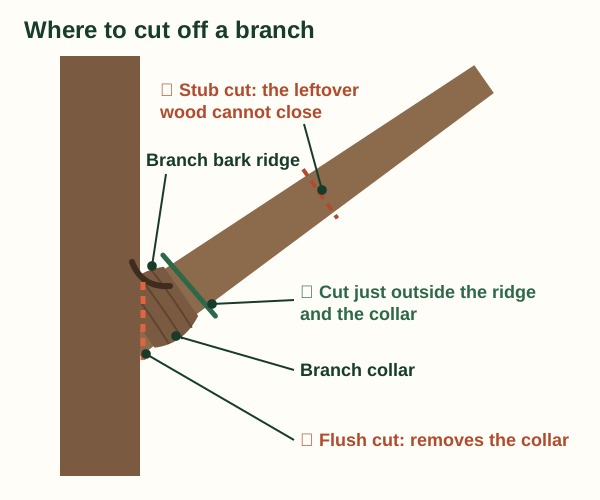
A removal cut takes a branch back to its point of origin. Two landmarks define where it goes, and neither of them is the trunk face. The branch collar is the swelling where the annual growth rings of trunk and branch overlap, interleaving like a shuffled deck of cards. The branch bark ridge is the raised line of bark where trunk bark meets branch bark, and it mirrors the branch's angle of attachment.
Begin the cut just outside the branch bark ridge and angle down and slightly away from the trunk, following the angle the branch bark ridge suggests, without cutting into the collar. On a branch rising at a narrow angle that cut is nearly vertical; on a wide-angled branch it slopes. There is no universal 45 degrees.
A flush cut removes the collar along with the branch. That destroys the tissue the tree uses to wall off decay and produces a much larger wound than the branch diameter suggests. A stub cut leaves wood beyond the collar that has no way to close; it dies back and becomes an entry court for decay running inward past the branch protection zone. Both are common, and both are worse than the branch you were trying to remove.
A reduction cut shortens a limb back to a lateral branch that can take over the terminal role. The lateral must be at least one-third the diameter of the stem being removed — reducing a 1-inch branch means cutting to a lateral at least a third of an inch across. Below that ratio the lateral lacks the leaf area and stored energy to take over, close the wound, and suppress water sprouts, and the cut behaves like a heading cut no matter what you call it.
A heading cut shortens a shoot to a bud or to no particular target. It has legitimate uses in shrubs, hedges, and fruit-tree training, and it is the wrong tool on a mature shade tree, where it produces clustered, weakly attached regrowth.
That one-third ratio is also the definition line for topping. Topping is not "cutting a lot" — it is the indiscriminate cutting of branches back to stubs or to laterals too small to assume the terminal role.
Use three cuts for a heavier branch
For any limb larger than about an inch (2.5 cm) in diameter, a single cut will tear bark down the trunk as the branch falls. Use the drop-cut sequence:
- Undercut. Twelve to eighteen inches (30–45 cm) out from the attachment, cut upward from below, one-third to halfway through the branch.
- Drop cut. From the top, slightly farther out than the first cut, all the way through. The limb falls, and any tear stops at the undercut instead of running down the trunk.
- Final cut. Remove the remaining stub just outside the branch collar.
Remove less than you think
Published guidance clusters around a ceiling of 25 percent of the crown within a growing season for a healthy established tree — the figure usually cited from the industry pruning standard. Dose scales with age: extension guidance adapted from the standard arboricultural texts allows roughly 50 percent for a young, healthy tree being trained, about 25 percent for healthy trees in their twenties to forties, and no more than 10 percent for an old tree in good health. For shrubs and plants generally, about a third of the total crown in one year is the usual ceiling.
These figures are maximums, not targets. Remove only what the stated objective requires, and stay well below the ceiling during routine annual pruning.
A more useful target, because you can measure it on the tree in front of you, is live crown ratio: keep live crown occupying at least 60 percent of total tree height. A tree whose live crown has been pushed below that is being over-raised or over-thinned.
Time pruning to the plant and the goal
Dead, damaged, and dangerous wood comes out whenever you find it. Everything else has a season.
The general default for deciduous trees is the dormant season, when structure is visible, most pests and pathogens are inactive, and the plant is not spending stored energy on foliage it is about to lose.
For flowering shrubs the rule turns on where the flower buds form. Shrubs that flower on old wood set buds during the previous growing season, so dormant pruning removes this year's flowers — prune them shortly after they finish flowering. Shrubs that flower on new wood form buds on the current season's growth, so prune in late winter or early spring before growth starts.
| Plant | Blooms on | When to prune |
|---|---|---|
| Lilac, forsythia, mockorange, beautybush, many viburnums | Old wood | Right after flowering finishes |
| Hydrangea macrophylla (bigleaf) | Old wood — buds set in late summer and autumn | Immediately after flowering; or wait for spring growth so you can see what survived and remove only dead wood |
| Hydrangea paniculata (panicle) | New wood | Late winter or early spring |
| Hydrangea arborescens (smooth, 'Annabelle' types) | New wood | Late winter or early spring; tolerates removing a third to half the shrub's mass |
| Clematis, group 1 (early, on last summer's shoots) | Old wood | Little needed; if pruned, after flowering |
| Clematis, group 2 (large-flowered hybrids) | Both | Late winter or early spring, then lightly after the first flush |
| Clematis, group 3 (late summer) | New wood | Late winter or early spring, hard |
If a clematis label is long gone, the field shortcut is straightforward: flowering before early summer means leave it alone; flowering from late June onward means prune in late winter. Note that reblooming bigleaf hydrangea cultivars flower on both old and new wood, which is why contradictory advice circulates for what looks like the same plant.
Disease windows, and the one time to paint a cut
Several diseases turn a fresh pruning cut into an infection court, and for those the calendar matters more than technique.
Oak wilt
This is the highest-stakes timing rule in pruning, because oak wilt kills red oaks in weeks and spreads through the root grafts of connected stands. The mechanism explains the rule: sap-feeding beetles feed on fungal spore mats that form under the bark of oaks killed the previous year, then fly to fresh wounds on healthy oaks. The wound is the infection court, the beetle is the vector, and the season is when both are active.
Do not prune oaks during the high-risk period, which runs from spring into midsummer — but the exact window differs enough by region that a national date range would mislead. Minnesota's guidance treats November through March as safe, April through July as high risk, and August through October as low. Michigan names April 15 to July 15 as the high-risk window. Texas guidance is different again, advising against pruning or wounding from February through June, and recommending that all oak wounds be painted immediately regardless of season because live oak stands transmit through root grafts and the beetle season starts earlier. Look up your own state's forestry agency or extension service for local dates.
Fire blight
On apple, pear, and related plants, cut a minimum of 8 to 12 inches (20–30 cm) below the last visible symptom, because the bacterium runs ahead of the visible margin. Cut into wood at least two years old, and prune in dry weather. Dormant-season removal is preferred: cankers are visible on bare wood, the bacteria are dormant, and tool disinfection between cuts is not necessary in winter.
For cuts that must be made during the growing season, the "ugly stub" method is worth knowing: remove infected wood 8 to 12 inches below symptoms but deliberately leave a bare stub of roughly 4 inches in two-year-old or older wood, rather than cutting back to a healthy limb or spur. A small canker then forms on the expendable stub rather than on structural wood. Mark those stubs and remove them during winter pruning.
Disinfect tools when disease is present
Seventy percent isopropyl alcohol works straight from the bottle, needs only a wipe or dip rather than a soak, and is far less corrosive than bleach — the practical choice. A 10 percent household bleach solution (one part bleach to nine parts water) requires soaking, rinsing afterward to limit corrosion, and discarding within about two hours, since bleach loses roughly half its activity in that time.
Keep tools clean of sap and soil and keep them sharp. Disinfect between cuts when removing diseased tissue or moving between plants during an outbreak. For fire blight, the decisive step is cutting 8 to 12 inches below visible symptoms; disinfection does not compensate for a cut made too close to the canker.
Conifers and the dead zone
The old-wood and new-wood logic above is about deciduous shrubs, and applying it to conifers causes the most common irreversible pruning mistake in home landscapes.
Most conifers have a dead zone toward the center of the plant where foliage has dropped and no green remains. Cutting back into it produces no regrowth and a permanent bald patch, in any season. Most conifers cannot resprout from old wood at all. Yew (Taxus) is the reliable exception, carrying dormant buds on old wood and tolerating drastic renovation; other species are described inconsistently and should not be gambled on.
The operational rule is short: never cut a conifer branch back past the last green needles. Prune within the green.
Pines work differently again, because they do not form lateral buds along the stem — they produce a whorl of buds at the end of each shoot. They are shortened by candling: pinching or cutting the elongating new candle in spring, during active shoot growth, which controls size while leaving time for terminal buds to form for the following year.
Renovating an overgrown shrub
Multi-stemmed, cane-type shrubs that have become leggy and bare at the base can be renewed two ways.
Gradual renewal removes a third of the oldest, largest-diameter stems completely to ground level in year one, the next oldest third in year two, and the remainder in year three. The shrub is never leafless and keeps flowering throughout. This is the low-risk option.
Hard rejuvenation cuts every stem back to within 4 to 6 inches (10–15 cm) of the ground in early spring before growth starts, producing a flush of new shoots that season. It is faster but costs a year of flowers, and it only works on species that resprout from the base.
Species that tolerate this treatment include lilac, forsythia, beautybush, mockorange, viburnum, redtwig dogwood, barberry, butterfly bush, flowering quince, smokebush, privet, honeysuckle, potentilla, sumac, spirea, weigela, summersweet, sweetshrub, and hydrangea. The exclusions matter as much: single-stemmed shrubs, grafted plants — where you will get rootstock rather than the cultivar you paid for — and nearly all conifers do not belong on that list.
Hedges: keep the base wider than the top
Trim a hedge to a slight taper, narrowest at the top. The reason is light, and the failure is progressive: a hedge narrower at the base shades its own lower branches, which lose their leaves and die back. The condition worsens each year, producing a bare-legged hedge that no longer screens — and on most species that bare wood will never refoliate.
Training fruit trees
Fruit trees are trained to a form, and the form determines light penetration and therefore fruit quality.
Central leader suits apples and sometimes pears: a single dominant trunk with a Christmas-tree outline, lower branches wider than upper. Typical spacing for a semi-dwarf apple puts the lowest scaffold roughly 18 to 22 inches above ground — deliberately not on the southwest side, where sunscald exposure is worst — with scaffolds spaced several inches apart vertically. Modified central leader keeps a dominant leader with three to five scaffolds spaced at least 6 inches apart, and is structurally strong for larger trees at some cost to inner-canopy fruit quality. Open center, or vase, removes the leader entirely and is the standard for peaches and nectarines: three to five scaffolds radiating from a trunk roughly 18 to 30 inches high, spaced at least 6 inches apart.
One rule of thumb ties this back to the rest of the guide: a scaffold's diameter should be less than half the diameter of the adjacent trunk. A limb more than half the trunk's diameter is a codominant stem, not a branch.
The most useful and least intuitive idea in fruit pruning is that timing changes vigor in opposite directions. Dormant pruning invigorates: removing wood in winter concentrates stored root and trunk carbohydrate into fewer growing points, so the tree answers with vigorous upright shoots. This is exactly why hard winter pruning to "control size" backfires. Summer pruning devigorates: cutting actively growing shoots and leaves reduces leaf area and food production, which is how growers hold dwarf and semi-dwarf apples at a target size. Summer pruning has real trade-offs — sunburn on newly exposed fruit and bark, and timing relative to harvest — so read your extension service's cautions before adopting it.
Palms invert most of these rules
If you garden where palms grow, almost everything above stops applying.
Never remove live, green, healthy fronds. Routine palm pruning is limited to completely dead fronds, damaged leaves, and flower or fruit stalks. The working guide is the 9-to-3 rule: keep all fronds above the horizontal plane — the 9 o'clock to 3 o'clock positions on a clock face — and prune only below that line, and only what is dead.
Do not remove yellowing fronds either. Potassium is mobile in palms, so a palm relocates it out of older leaves; yellowing fronds are usually a symptom of deficiency, and cutting them off removes the reserve the palm is drawing on and makes the deficiency worse. The "hurricane cut" — stripping the canopy back to a few upright fronds — compromises the palm's structure in high winds rather than improving it.
After a storm
Triage before you cut. Remove a tree with a split trunk, a disease-weakened base, or more than half of its crown gone; it has lost the structural or physiological margin needed for recovery. Have an ISA Certified Arborist evaluate a tree that lost its central leader, especially a species whose mature form depends on one dominant trunk.
Then do the minimum and wait. Remove damaged limbs only; the tree needs every remaining leaf to get through the next season. Small torn limbs up to about an inch take a single clean cut at the collar to stop bark stripping; anything larger takes the three-cut sequence. Do not top it, do not apply wound dressing, and do not fertilize to "help it recover."
After the cut
Leave the wound alone. Keep the root zone mulched and watered, and do not fertilize to force growth after heavy pruning — you are asking for the weak, rapid regrowth you were trying to avoid.
Then watch what the plant does. Dense vertical regrowth around a cut means you removed too much or cut to a lateral too small. Dieback beyond a cut means the cut was too far from a bud or lateral, or the plant was already stressed. Both are information for next season.
Hiring someone, and checking them
ISA Certified Arborist is the baseline credential. TRAQ — the ISA Tree Risk Assessment Qualification — is a separate credential for assessing whether a tree is likely to fail and what the consequences would be. That is a different question from how a tree should be pruned, and it is the credential to ask for when the question is "is this tree dangerous?" Credentials are publicly verifiable through the ISA's searchable directory of credential holders. Note that ISA qualifications are not a license: state or municipal licensing, where it exists, is separate and must be checked separately.
On insurance, ask that a certificate — liability for personal and property damage, plus workers' compensation — be sent to you directly from the insurance agent rather than handed over by the contractor. If an uninsured worker is injured on your property, the exposure can land on you.
Three red flags are worth knowing:
- Door-knockers, especially after a storm. Reputable firms generally have all the work they can handle. Treat demands for advance payment and "special price if you decide today" the same way.
- Anyone who offers topping as a service. It is not an accepted maintenance practice, and advertising it is a competence signal.
- Climbing spikes on a tree that is not being removed. Spikes wound the trunk at every step and open entry points for decay. A conscientious arborist uses them only for removals.
Get more than one estimate, and get the scope in writing using the standard vocabulary — clean, thin, raise, reduce, restore — with a target percentage and a minimum lateral size. A written specification is what makes "do not top it" enforceable.
Sources and further reading
- US Occupational Safety and Health Administration: Line-clearance tree trimming operations — minimum approach distances and qualification levels.
- Penn State Extension: Understanding the spread of decay in trees — compartmentalization rather than healing.
- Utah State University Extension: Tree injuries — the CODIT response.
- Colorado State University Extension: Pruning cuts — branch collar, branch bark ridge, and cut angle.
- NC State Extension: General pruning techniques — flush and stub cuts, the one-third lateral rule, and dose by tree age.
- UF/IFAS Gardening Solutions: Pruning in three steps — the drop-cut sequence and distances.
- Colorado State University Extension: Structural pruning of young shade trees — removal percentages and live crown ratio.
- Tree Care Industry Association: ANSI A300 Part 1, Pruning — the five pruning types.
- Illinois Extension: Tree topping is never a good option.
- Clemson Cooperative Extension: Topping trees.
- Minnesota DNR: Oak wilt management — the seasonal risk calendar.
- Michigan State University Extension: Preventing oak wilt.
- Texas A&M Forest Service: Prevent the spread of oak wilt in Texas — different window, and paint year-round.
- Iowa State University Extension: Pruning oak trees to avoid oak wilt — the wound-paint exception.
- Ohio State University Extension: Pruning wound dressings.
- University of Minnesota Extension: Fire blight — cutting distance below symptoms.
- University of Maryland Extension: The ugly stub method for fire blight.
- Michigan State University Extension: When to prune out fire blight — the evidence on tool sanitation.
- University of Missouri IPM: Cleaning pruning tools — disinfectant concentrations and contact times.
- University of Minnesota Extension: Pruning hydrangeas for best bloom.
- Royal Horticultural Society: Clematis pruning guide — the three pruning groups.
- Iowa State University Extension: Pruning large, overgrown shrubs — gradual renewal and hard rejuvenation.
- Penn State Extension: Pruning needled evergreens — the dead zone.
- UMass Extension: Pruning needled evergreens.
- Michigan State University Extension: Pruning pines — candling.
- University of Maryland Extension: Pruning shrubs and hedges — hedge taper.
- Illinois Extension: Training fruit trees — central leader, modified central leader, open center.
- Illinois Extension: Making pruning cuts on fruit trees — why dormant pruning invigorates.
- UC Agriculture and Natural Resources: Summer pruning deciduous fruit trees.
- UF/IFAS Gardening Solutions: Pruning palms — the 9-to-3 rule and why not to cut yellowing fronds.
- University of Missouri Extension: Care of storm-damaged trees — the 50 percent crown threshold.
- OSHA: Line-clearance tree trimming operations — the 10-foot minimum approach distance.
- Alabama Cooperative Extension: Chainsaw safety and personal protective equipment.
- University of Missouri Extension: Chainsaw safety.
- International Society of Arboriculture: Tree Risk Assessment Qualification.
- ISA: Verify a credential holder.
- Nebraska Forest Service: How to select an arborist or tree service — insurance and red flags.